Showing posts with label the everlasting stone. Show all posts
Monday, December 5, 2016
Richard Tipping - Everlasting Stone #22 - Let Go
Let Go 1980 Granite, engraved text, goldleaf. Dimensions 10 x 32 x 7.3 cm
Possibly included in the exhibition Word Works 2 at Powell Street Gallery in Melbourne, 1980. Included in the exhibition Hear the Art at the Eagle Gallery, London, in 1997, and returned to Australia in 2010. Thirty years plus. Even a small granite word work like this weighs about 4.5 kg. Giving weight to words.
At the point of letting go you fall through the O as a hole in space.
The dictum to 'let go' retains its potency in the Buddhist sense of releasing ourselves from attachments. Dharma as cosmic law and order, and as the teachings of the Buddha. The three Jewels: "I take refuge in the Buddha, the Dharma, the Sangha" ... while wishing that less people needed monotheism.
Personally, I'm very attached to these 'everlasting stones' and have no intention to 'let go' whatsoever: it is life which will let go of me some day before long).
Let Go 1997 Wood, brass hinge, engraved text, goldleaf.
Dimensions: 9 x 24 x 4 cm (closed); 9 x 48 x 2 cm (open)
Declared as an edition of 21 but only about a dozen made.
Shown in the exhibitions Heart the Art at the Eagle Gallery, London, in 1997; and Versions at Ubu Gallery, New York, in 1998-99. I have two left. One is hiding inside an artwork at the Art Gallery of New South Wales (sssshh!); and two are in my studio. Like a lot of editions, I have no idea where most went.
Sunday, December 4, 2016
Richard Tipping - Everlasting Stone #21 - Time has Stopped
Paradiso, India 1990
Granite, engraved text, goldleaf. Dimensions: 11.2 x 18.6 x 2.0 cm
I learn from a web search that this is indeed from India: "Paradiso Classico Granite is a fine-grained, purple migmatite of the Precambrian period with dark grey-purple background sometimes with heavy grey-black veining and a lot of movement." This small piece was given to me as a sample.
The 'shadow' font creates letters through their absence, emphasised by goldleaf.
We know that time itself, whatever time is (for even with our mastery of physics we hardly know at all) cannot stop. Whose time has stopped? A being experiencing time, a subjective participant, a living consciousness (can there be consciousness not living? can a stone feel? is my mind real? The object states an impossible physical condition in a language made of emphatic shadows.
Saturday, December 3, 2016
Richard Tipping - Everlasting Stone #20 - Sea Threw
Sea Threw 1979 Blue pearl granite, engraved text, goldleaf.
Dimensions (approx) 20 x 25 x 6 cm. Collection of the Sackner Archive
of Visual and Concrete Poetry, Miami. Shown at the solo exhibition Airpoet at Robin Gibson Gallery, Sydney, in 1980. Bought by Marvin Sackner circa 1982.
The words are in a 'shadow' font, the goldleaf emphasising the absence of the letters themselves, which are created by their shadows. Blue pearl granite is one of the most beautiful, and highly prized, with its layered reflections like luminous fish scales. Wikipedia says that this granite (an igneous rock) is larkavite, quarried in Norway, "notable for the presence of handsome, thumbnail-sized crystals of feldspar", and is around 300 million years old.
Friday, December 2, 2016
Richard Tipping - Everlasting Stone #19 - Somewhere in France
Somewhere in France ...1917
Granite, marble, wood, anti-conscription badge, engraved text, goldleaf. Made in 1991 and 1994. Dimensions: 37 x 47 x 29 cm
The figures of the soldiers is based upon the famous photograph by Frank Hurley of Australian troops walking along the edge of a rain-filled crater towards the front line, taken in 1917. Postcards home by soldiers could not state place names: "Somewhere in France" was all that was allowed. The agonising war bogged down, with nothing but rising casualties. Back in Australia, there was a campaign against the government's attempt to introduce conscription, using the slogan: "Fight as free men not as conscripts". This campaign succeeded.
An original badge is glued onto the front of the sculpture ...
This 'everlasting stone' is a memorial, recalling the power of contemporary media with the three elements mentioned: an iconic photograph, an anti-conscription badge, and the officially approved place name.
This sculpture was shown in the solo exhibition Only Emotion Endures at Australian Galleries in Sydney in 2008. The Australian War Memorial was approached, and were interested in acquisition but "don't have any funds".
As usual, as long as the artist is happy to give their work for free, all's good.
Thursday, December 1, 2016
Richard Tipping - Everlasting Stone #18 - Critical Mass
Critical Mass, 1980. Blue pearl granite, engraved text, goldleaf and silver paint.
Dimensions: 15 x 67 x 7 cm. Collection of the artist.
Critical mass is the minimum amount of fissile material needed to maintain a nuclear chain reaction. Critical mass could also mean a church mass full of criticism, ie a mass criticising something, or full of critical (important) material. Mass media being critical? The current trend is instead towards blurring truth, making lies into seeming facts through repetition, curtailing debate.
The presence of the 'gold bar' shifts the capital 'c' to a lowercase 'k'. The critical becomes kritical, and as with the spelling of America as Amerika, there is an implied threat. Simultaneously, the 'critical mass' presses against a mysterious precious point: perhaps this is a trigger point, the moment before explosion.
Dimensions: 15 x 67 x 7 cm. Collection of the artist.
Critical mass is the minimum amount of fissile material needed to maintain a nuclear chain reaction. Critical mass could also mean a church mass full of criticism, ie a mass criticising something, or full of critical (important) material. Mass media being critical? The current trend is instead towards blurring truth, making lies into seeming facts through repetition, curtailing debate.
The presence of the 'gold bar' shifts the capital 'c' to a lowercase 'k'. The critical becomes kritical, and as with the spelling of America as Amerika, there is an implied threat. Simultaneously, the 'critical mass' presses against a mysterious precious point: perhaps this is a trigger point, the moment before explosion.
Tuesday, November 29, 2016
Richard Tipping - Everlasting Stone #17 - Within Without
Within You and Without You, 2007
Granite sheet on granite base, engraved text, goldleaf. H 55 x W 18 x 2 cm
on base 2 x 30 x 21 cm.
Shown at the solo exhibition Studio at Australian Galleries, Sydney, in 2012.
I'm glad Within Without didn't sell, as it's a pleasure to have in the studio. In fact, I've decided not to sell any of my remaining Everlasting Stones, of which there must be at least fifty in various corners and on shelves. You can reach a point where the speaking-to-you 'thingness' of a sculpture becomes a necessary presence, a marker in the flux, a constant re-iteration of complexities. Those who like their poems to be stories will find all this somewhere between puzzling and appalling. Why would anyone spend so much time inside words, feeling their depths and crags, mountain climbing syllables, diving into pools of vowels? Using symmetrical letters, splitting the word vertically, creating filled emptiness.
If you remove the 'H' and re-arrange words, there is easily 'out wit' there - but that's a distraction.
As George Harrison's song says: "Life goes on within you and without you"
See various recordings and covers on YouTube for example.
There's also a great Patti Smith version of Within Without You:
Monday, November 28, 2016
Richard Tipping - Evolution Sucks #16 - Innocence & Experience
Innocence & Experience, 1979.
Black granite, engraved text.
Dimensions say H 15 x W 40cm, to be confirmed.
Photographed in a butcher's window, 1980. Private
collection, Sydney. This is the only record I have of this sculpture. Sold at the solo exhibition Airpoet at Robin Gibson Gallery, Sydney, 1980. The human as tiger? We breed our prey.
And water'd heaven with their tears:
Did he smile his work to see?
Did he who made the Lamb make thee?"
William Blake, in The Tyger, in Songs of Innocence and Experience
https://en.wikipedia.org/wiki/The_Tyger
Sunday, November 27, 2016
Richard Tipping - Everlasting Stone #15 - Rent Now Rent Asunder
Rent Now, Rent Asunder, 1978-79. Black granite, engraved, goldleaf. Dimensions approx 50 x 35 x 10 cm (to be confirmed). Made in Adelaide, shown at my exhibition The Everlasting Stone at Adelaide Festival Theatre in 1978. This photograph shows Rent in the garden of a friend to whom I gave this work when moving to the east coast permanently from Adelaide in late 1979. Thirty five years later, while visiting my old home town, I rescued Rent from his old house, where it had been left behind, swapping an editioned reflective Notice sign with the new owner. The sculpture had been badly treated, and was broken on both top corners. The trouble with sculpture is that it's like keeping an eye out constantly for the welfare of your children, and helping where you can.
This close-up photograph shows Rent Now, Rent Asunder standing alone. The next photograph was taken at the exhibition The Everlasting Stone in 1978, and shows the edition of three placed on a table. There is a 'sold' sticker on the front one - two sold, and I gave the third to my friend. Now that one has been repaired, and with goldleaf, and is back in the garden, my garden this time. Remembering all those years of renting houses. Burying the rent. Only an 'r' sits between buying and burying. Our lives rent asunder.
Saturday, November 26, 2016
Richard Tipping - Everlasting Stone #14 - Speaches
Speaches, 1979. Black granite, engraved text, silver paint and gold leaf. Font by John Glasson, stone mason, Adelaide. Dimensions approx 20 x 60 x 18 cm. Collection of the artist.
Sweet talk - speeches/peaches - poetry and song entwined through melody.
The 'S' is a graphic elaboration of the way a capital 'S' is drawn in the copperplate script which I learned at school in the 1950s; and feels like a musical clef floating free of its stave.
Sweet talk - speeches/peaches - poetry and song entwined through melody.
The 'S' is a graphic elaboration of the way a capital 'S' is drawn in the copperplate script which I learned at school in the 1950s; and feels like a musical clef floating free of its stave.
Wednesday, November 16, 2016
Richard Tipping - Everlasting Stone #12 - Like This Like You
Like This Like You, 1977
Granite, engraved text, goldleaf. Dimesions say W 28 x H 30 x D 24 cm.
Collection of the estate of Mazie Turner. Proposed acquisition by the Art Gallery of New South Wales, Sydney 2016. Photograph by Mazie Turner, 1980.
Like as a conjoiner, comparing, equivalence, affection. The word like in poetry is the essential tool of simile. Like can be a preposition, a conjunction, a noun, an adjective and an adverb.
A Google search for "like - meaning" shows the variety of these uses.
Tuesday, November 15, 2016
Richard Tipping - Everlasting Stone #11 Lamb
Innocence & Experience, 1979.
Black granite, engraved text. Dimensions say Width 40cm. Photographed in a butcher's window, 1980. Private collection, Sydney. This is the only record of this work, bought by Peter Lamb at the solo exhibition Airpoet at Robin Gibson Gallery, Sydney, 1980. Humans as the Tiger?
"When the stars threw down their spears / And water'd heaven with their tears: /
Did he smile his work to see? / Did he who made the Lamb make thee?"
William Blake, The Tyger, in Songs of Innocence and Experience
https://en.wikipedia.org/wiki/The_Tyger
Monday, November 14, 2016
Richard Tipping - Everlasting Stone #10 - Imagination is No More Important
Imagination is No More Important, 1991/2016. Granite, engraved text, goldleaf.
Dimensions: H 32.5 x W 45 x D 3 cm, on base H 3 x W 49 x D 11 cm. Private collection, Sydney.
Albert Einstein, quoted in an interview in What Life Means to Einstein (1929), said: "Imagination is more important than knowledge. For knowledge is limited, whereas imagination embraces the entire world, stimulating progress, giving birth to evolution."
In this sculpture the NO interferes, balancing the books. Another NO sits by the signature: a double negative?
“There are two ways to live: you can live as if nothing is a miracle; you can live as if everything is a miracle.” Albert Einstein.
Dimensions: H 32.5 x W 45 x D 3 cm, on base H 3 x W 49 x D 11 cm. Private collection, Sydney.
Albert Einstein, quoted in an interview in What Life Means to Einstein (1929), said: "Imagination is more important than knowledge. For knowledge is limited, whereas imagination embraces the entire world, stimulating progress, giving birth to evolution."
In this sculpture the NO interferes, balancing the books. Another NO sits by the signature: a double negative?
“There are two ways to live: you can live as if nothing is a miracle; you can live as if everything is a miracle.” Albert Einstein.
Sunday, November 13, 2016
Richard Tipping - Everlasting Stone #9 - Sea Song
Sea Song, 1998. Six beach stones, engraved text. Dimensions: lengths vary from say 10 - 20 cm.
"The six words ... pebble / beached / glistening / grains
/ stones / clouds
become, as each word opens to reveal its
inner sound:
c loud s / s tone s / g rain s / g listen ing /
b each ed / p ebb le
Twelve words within six. This is a seascape, not
a contemplation arising from absorbed and contemplated silences in the depths
of the woods like Thoreau, but from
walking in the ‘wildness’ of Australian beaches where it is easy to find
oneself completely alone. The sequence is not static but has the dynamic
interactions of the sea’s littoral zone. Hugeness of scale, a 'lion-maned' sea set with
burgeoning clouds, the long arc of beach stretching away into mist. You are walking, notice the glisten on wave-rubbed pebbles. You pick one up and
feel its wet weight in your hand, and then hurl it back into the sea to be
washed up again on the next tide. The swoosh of the spent waves sucking back on
‘each ebb’, and a sense of tides. The sound of rain, filled emptiness."
From a chapter of my doctoral essay Word Art Works: visual poems and textual objects (University of Technology, Sydney, 2007) which is being slowly turned into a book.
Saturday, November 12, 2016
Richard Tipping - Everlasting Stone #8 - Evolution Sucks
Evolution Sucks, 1976. Black granite, engraved letters, goldleaf. Dimensions: H 42 x W 35 x D 6 cm. Font design by John Glasson, stone mason. Made in Adelaide in 1976, this is the first of the Everlasting Stone series of 'minimal poems' made between 1976 and 2016 in granite, marble and stone.
Two examples of Evolution Sucks were made. One (#1) is in the collection of the estate of Brett Whiteley, Sydney, bought from the solo exhibition Airpoet at Robin Gibson Gallery in 1980; the other (#2) has been repaired after damage caused during moving by a collector. This sculpture (#2) was refused as a donation to the Art Gallery of South Australia in 2015, which has to be a compliment. This photograph shows #1 on the edge of a quarry which was once near to Glenmore Road in Paddington, Sydney, in 1980. A clever real estate developer realised that the huge emptiness provided a free spot for a subterranean car park!
www.richardtipping.com
Friday, November 11, 2016
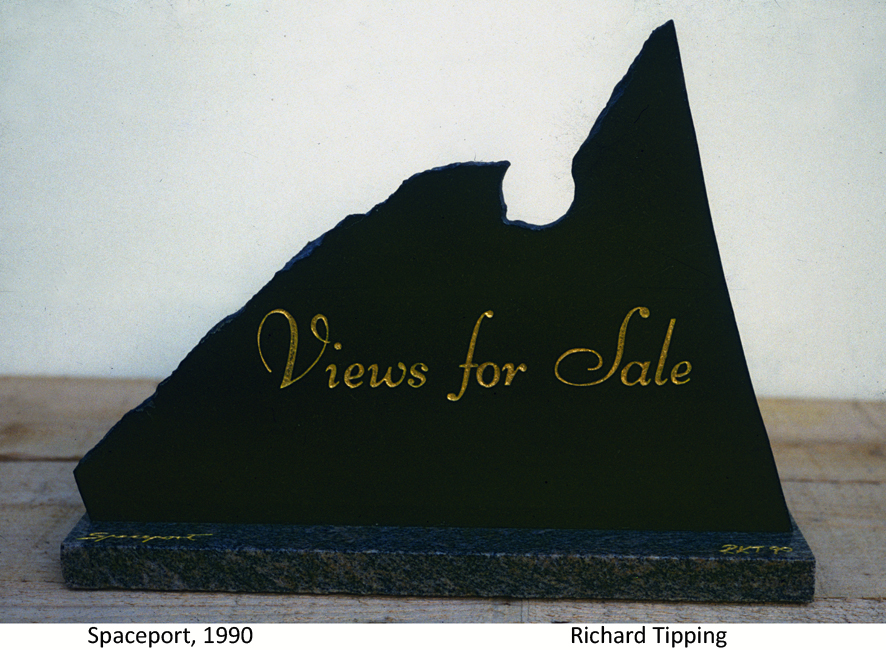
Richard Tipping - Everlasting Stone #7 - Spaceport
Spaceport, 1990. Black granite, engraved, finished with goldleaf, on a granite base. Dimensions (guessing): Height 30 cm x Width 36 x Depth 18 cm. Collection of the Gold Coast Art Gallery, gift of Pat Corrigan.
From a series made in the early 1990s using scraps of granite sheet. Spaceport imagines the coastal strip along Queensland with its perfect beaches and oggling towns, each with 'views for sale'. This may be a kind of map. The only view now is black and gold. My technique was to letter up the granite myself, putting on professional-grade tape and then gluing on a print-out ready to hand-cut, exposing the letters. Then order 'sand blasting' by a stone mason (using special equipment with zircon, not sand) , and finish with gold leaf.
www.richardtipping.com
Thursday, November 10, 2016
Richard Tipping - Everlasting Stone #6 - Object
Object, 1979 - black granite with engraved text. Dimensions say H 30 x W 40 x D 8 cm. The word play is between the object-ness of the granite 'thing', and the other meaning of 'object' as to protest or disagree. Post-object art is another name for conceptual art, sometimes called art-as-idea, a potent arena of practice in the 1970s. Here the 'idea' is a solid object, with a text which has no 'subject' or 'content' except the embedding of a 'delineation' (a 'marker'? a 'definition'?) of the self-contained thing-in-itself. So while being a conceptual work, is it conceptual art since it rests upon the power of the object? If the text instead means 'object to' (object to what? to the work?) then it is quite other. Shown at my solo exhibition Airpoet in 1980 at Robin Gibson Gallery, Sydney. Another 'minimal poem' from the series The Everlasting Stone, 1976-2016. This photograph is more than documentation, it becomes the work itself.
See more at www.richardtipping.com
Wednesday, November 9, 2016
Tuesday, November 8, 2016
Richard Tipping - Everlasting Stone #4 - Beijing Tiananmen
Beijing Tiananmen - engraved black granite, on granite base with natural stone - 1989
"The use of the American words “jeans” and “sneakers” is meant to suggest not only the ‘harmlessness’ of the citizens with their ‘universal rights’ as normal people wearing their everyday clothes, but their ‘western influence’, and the increasing role of China as a centre of manufacturing, including the low wages and poor working conditions for many who work making “jeans and sneakers” for the rest of the world. The formal layout and official-looking text on the stern symmetry of the upright granite is in contrast to the form of the egg-shaped natural stone placed onto the base. This is meant to represent the ancient ways, the appreciation of nature as a model for behaviour which is expressed in aspects of Taoism and Confucianism, both deeply influential in Chinese civilisation. This sculpture is in the collection of the Ruth and Marvin Sackner Archive of Visual Concrete Poetry in Miami. The image above was published as one of 24 postcards for the catalogue of Multiple Pleasures at the Art Gallery of New South Wales in Sydney in 1996."
Excerpt from Word Art Work doctoral essay by Richard Tipping 2007, from a book in progress.
Monday, November 7, 2016
Richard Tipping - Everlasting Stone #3 - Daybreak
Daybreak, 1977. Carrara marble sheet, engraved text, goldleaf. Height est 150cm.
Broken in a moving accident by a collector, and disposed of. Photograph by Richard Tipping, 1978. "The split of light imagined from the single point of sunrise. Day breaks across the waiting land."
The Everlasting Stone is a series of minimal poems in granite or marble, made between 1976 and 2016. These have been exhibited in Adelaide, Melbourne, Sydney, London and New York. Examples are in collections including the National Gallery of Australia, Canberra, and the Art Gallery of New South Wales, Sydney.
Broken in a moving accident by a collector, and disposed of. Photograph by Richard Tipping, 1978. "The split of light imagined from the single point of sunrise. Day breaks across the waiting land."
The Everlasting Stone is a series of minimal poems in granite or marble, made between 1976 and 2016. These have been exhibited in Adelaide, Melbourne, Sydney, London and New York. Examples are in collections including the National Gallery of Australia, Canberra, and the Art Gallery of New South Wales, Sydney.
Sunday, November 6, 2016
Richard Tipping - Everlasting Stone #2 - Moonday
Moonday, 1977. Angaston marble, engraved text. Dimensions 95.0 x 45.5 x 6.5 -16.5 cm. Collection of the Art Gallery of South Australia, Adelaide. Purchased 1984. Stone mason John Glasson. Moonday was included in my first solo exhibition The Everlasting Stone at the Adelaide Festival Centre Gallery in 1978.
"In Adelaide, where I
was living when it was made, the moon rises from behind the Mount Lofty Ranges
and sits huge and smouldering orange for a while on their shoulder of blue.
It’s as if the O has doubled, squeezing up and out of the word – the word left
as a horizon, a line of hills.” From printed notes on works included with the folio The Sydney Morning II, Thorny Devil Press, 1991, edition of 50.
Subscribe to:
Posts (Atom)